St Edmund's
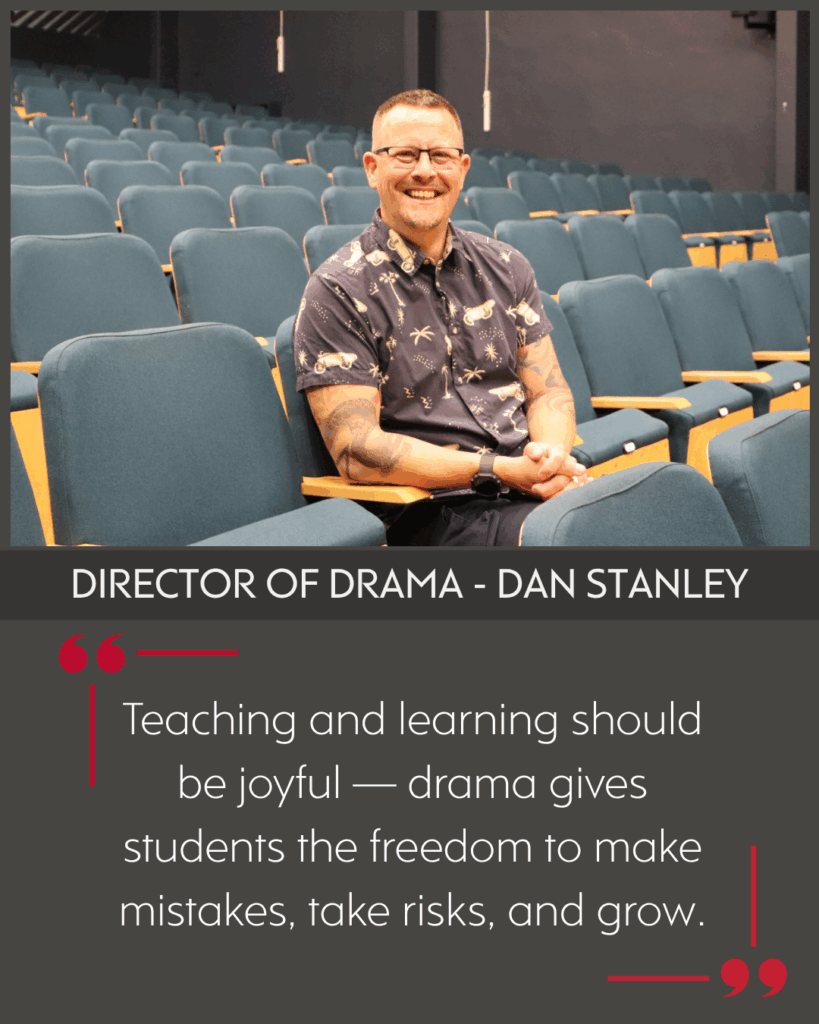
Meet Dan Stanley – Our new Director of Drama
Q: Can you tell us about your journey into drama and theatre?
Absolutely. I started my journey at the Oldham Theatre Workshop, working closely with David Johnson, the director there, who taught me a lot of my craft. I’m incredibly grateful to him — those early experiences shaped who I am today.
From there, I was lucky enough to gain a place at the National Youth Theatre. I did four seasons under the direction of Edward Wilson. It was a fantastic experience.
I went on to study a BTEC in Performing Arts and then attended Bretton Hall. Coincidentally, Rob — who also works here — also went to Bretton Hall. It wasn’t the most famous school, but for theatre it was exceptional.
From there, I pursued acting, but it didn’t quite work out for me. What did emerge was a deep passion for teaching drama. I found my path in helping young people learn through drama rather than chasing the acting career myself. And honestly, I wouldn’t change a thing.
Q: What’s your vision for drama at St. Ed’s?
That’s a big question! I’m still getting to grips with the role, but I truly believe in the importance of performing arts in students’ lives.
Drama provides young people with a wide range of ways to express themselves — whether they want to be actors, designers, directors, or technicians. And for me, it’s not just about teaching acting — it’s about learning through drama.
My vision is to build on the strong existing practice, while also raising the reputation of St. Ed’s beyond Kent. I’d love to explore international opportunities — maybe taking a piece of theatre on tour or entering festivals like Scarborough or Edinburgh.
Back in 1989, I went to Stuttgart, Germany, with Oldham Theatre Workshop, and it had a profound impact on me. That kind of experience can be transformative. Long-term, I’d love to open up similar opportunities for our students.
That said, this first year is all about finding our feet, supporting learning, and continuing the amazing journey that’s already underway.
Q: How do you think drama supports academic development?
Discipline is key. Drama requires focus, time management, collaboration — all vital skills that support academic growth.
Students who are involved in drama learn how to organise themselves, listen to others, solve problems, and work as part of a team. These skills are hugely transferable.
It’s also about resilience. Drama throws up challenges — whether it’s a tricky scene or a performance that doesn’t go as planned. Learning how to handle those setbacks is a life skill.
Ultimately, it’s about helping students take ownership of their learning and realise that making mistakes is part of the process.
Q: What can students expect in your classroom?
Creativity, focus, and discipline. I won’t hand them all the answers — I’ll coax their creativity out of them. We’ll use stimulus, exam questions, music, puppetry, mask work — all kinds of mediums.
Humour is important too. Teaching and learning should be joyful. I love music and often bring it into my lessons — it helps students express themselves emotionally and intellectually.
I also draw inspiration from Greek theatre — it’s a huge influence for me. There’s something magical about combining mask, movement, costume, and song.
Mistakes are welcome. I want students to know it’s okay to get things wrong. That’s how we learn and grow.
Q: Are there any upcoming productions or events we can look forward to?
Yes! We’ve already booked two theatre trips:
- The Woman in Black at Alexandra Palace in October
- Lost Atoms by Frantic Assembly at the Lyric Hammersmith in February
And I’m thrilled to announce our first senior production will be Arthur Miller’s The Crucible in late November. It’s a powerful, brooding piece that still resonates today.
We’re also applying to take part in the Shakespeare Schools Festival in March, with performances at the Gulbenkian Theatre. I’m hoping to involve the junior school in that.
I’ve done the festival before — around 12 seasons — and it’s always been a brilliant experience for students.
Q: What’s your dream production to direct?
It would have to be Coram Boy. It’s based on the Coram Society and features stunning music — Handel actually wrote The Messiah inspired by their work.
It’s not a musical, but it weaves together music, drama, and a powerful story of young women and destitution. I saw it at the National Theatre years ago and it left a lasting impression.
If I ever get the chance to combine live choir, orchestra, and a dramatic piece — that would be the dream.
Also, I’d love to do Jesus Christ Superstar one day. Rob and I were just talking about it — maybe in the future!
Q: What’s your favourite play or musical?
That’s a tough one!
Coram Boy is definitely up there.
I also love Billy Elliot — such a brilliant piece of theatre.
Recently I saw Hadestown — fantastic storytelling and music.
As for Shakespeare, I adore Macbeth, The Tempest, and anything with magic and mystery.
In terms of physical theatre, I’m a big fan of Stephen Berkoff and companies like Frantic Assembly — their work is right up my street.
Q: What advice would you give to a young performer?
Keep your head in the clouds, but your feet on the ground.
Dream big — always — but stay realistic. This industry is tough.
Try everything once. You never know what might be your calling — lighting design, directing, writing, singing. But you won’t discover it unless you give it a go.
And even if you don’t “make it” as a performer, the skills you gain from drama are invaluable for life.
Q: Tell us something fun or unexpected about you.
Here’s one: I once auditioned for Lord of the Rings — and lost the role to Orlando Bloom!
Turns out, he went to St. Ed’s too. Full circle, right?
At the time, it stung, but looking back, if that had worked out, I wouldn’t have met my wife, had my kids, or ended up here doing what I love.
Also, I love cooking — especially BBQs — and I’m definitely an outdoorsy type. If the weather ever improves, I’ll be out there grilling again!
And yes, I’ve heard about the flying club here — that’s just incredible. I’m excited to explore all the co-curricular opportunities St. Ed’s has to offer.
Q: One final thought?
Yes — in my drama studio, we don’t use the word “can’t.”
I always tell students: you’ll never know what you’re capable of until you try.
My goal is to make sure students feel safe, inspired, and proud of the experiences they have in drama — whether they become actors or not.