

St Edmund's
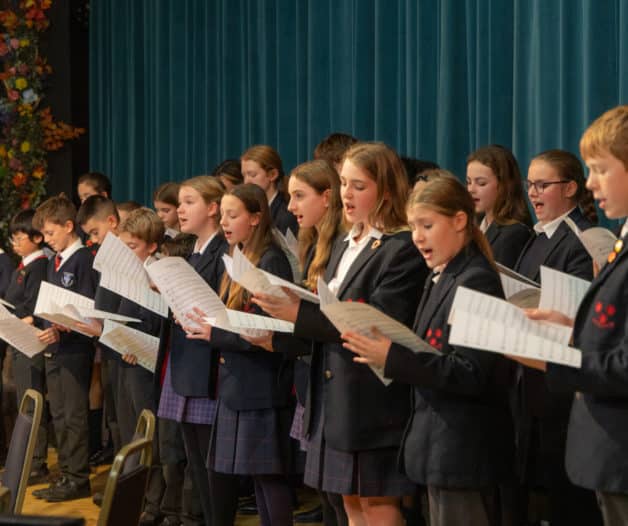
“Alive and well”: The St Edmund’s Choral Programme
There has been much talk in recent weeks about the future of choral music in the United Kingdom. It was especially saddening to read this article in The Telegraph.

At St Edmund’s School, choral singing remains at the heart of our identity as a school. For fifty years, we were a Cathedral Choir School. While that formal relationship ended two years ago, the knowledge and experience we have developed during that time, is still being put to exceptionally effective use. The St Edmund’s Choral Programme, supported by generous scholarships, offers young people, whatever their age or personal background the opportunity to receive an outstanding musical education. As Benjamin Britten said, “Children have an instinctive feeling for music, and if encouraged, they can achieve astonishing things.”
Pupils involved in the Choral Programme at St Edmund’s rehearse in the morning before school, starting with physical and vocal warm-ups to gently wake up the body and vocal cords. We then move onto sight-singing, a valuable skill for all musicians, to enhance reading music and widen access to a variety of musical styles. Core repertoire and part-singing is covered so that our envious choral tradition is preserved, culminating in regular Chapel performances, services and helping to support membership of the seven regular school choirs. Most pupils also learn instruments and belong to other ensembles which significantly enhances their all-round musical experience; it is quite normal for St Edmund’s pupils to achieve music diplomas whilst still at school. They also have the opportunity of performing in major venues at home and abroad; our recent tour to Austria included a well-received sacred music concert in Salzburg Cathedral. Many often go onto music conservatoires or top universities and the experience has had a profound impact on helping them achieve success in their future careers.
At its heart, choral singing is one of the most democratic musical experiences available. It requires no expensive instrument, no prior technical mastery, and no exclusivity. Voices of different ages, backgrounds and abilities can stand side by side, contributing to a shared sound that is greater than the sum of its parts. In a country wrestling with questions of identity, belonging and cohesion, choirs offer a rare space where cooperation, listening and mutual respect are not abstract ideals but practical necessities.
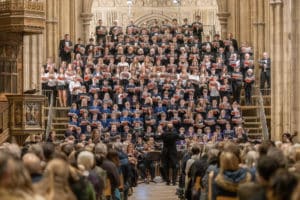
The social value of choral music is profound. Britain faces rising levels of loneliness, particularly among young people and older adults. According to the Office for National Statistics in 2025, 31% of 16–29-year-olds felt lonely “often or some of the time” and the Youth Matters State of the Nation report found that 44% of 11–18-year-olds regularly feel lonely. Choirs counter this directly. Rehearsals provide routine, friendship and a sense of purpose; performances create shared goals and collective pride. Research consistently shows that singers report stronger feelings of connection and wellbeing than non-participants. The simple act of breathing together, matching pitch and shaping phrases creates a powerful sense of unity. As John Rutter said,
” For me, choral music is the most human of all music, because it is made by voices breathing together. ”
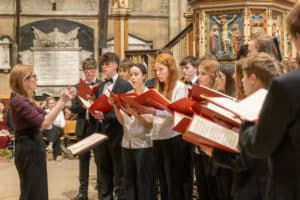
There are also clear mental-health benefits. Choral singing has been shown to reduce stress hormones, improve mood and support emotional regulation. For example, a 2024 study of choir singers found that longer choir membership, more singing hours and higher engagement were associated with larger improvements in mental health and wellbeing. Similarly, research from the University of Oxford shows that group singing not only forges social bonds quickly but helps strengthen broader social networks, which supports happiness and social wellbeing. Also, a 2025 neurocognitive study reported that frequent choir singing was associated with reduced depressive symptoms and trends toward improved psychological quality of life.
Unlike solitary music consumption, singing in a choir demands presence: attention to the conductor, awareness of others, and engagement with the music in the moment. In a culture dominated by screens and constant distraction, this form of focused, embodied activity is invaluable. Focus is the new “superpower.”

Educationally, choral music remains one of the most effective ways to develop musical literacy. Through choir, young people encounter harmony, rhythm, language and discipline in an integrated and accessible way. They learn to take responsibility not only for their own line, but for how it fits into a wider structure—an essential insight for developing teamworking skills. Importantly, choral music also nurtures confidence: standing up to sing as part of a group is often a young person’s first experience of public performance in a supportive environment.
Finally, modern choirs are increasingly diverse in repertoire and membership, reflecting the complex, evolving nature of modern society. So, the choral tradition is alive and well at St Edmund’s. If you would like to find out more, please contact Spencer Payne our Director of Music at sjp@stedmunds.org.uk